


Look up on a clear night far from city lights and you will feel something that every human being who has ever lived has felt before you. A pull. A sense that the sky is not random but arranged, that the lights scattered across the darkness form shapes that mean something, that tell something, that connect you to a story older than any civilization currently standing. That feeling is not poetic imagination. It is the residue of tens of thousands of years of human beings doing exactly what you are doing, looking up, finding patterns, and weaving those patterns into the stories that helped them navigate the world, mark the seasons, and understand their place in a universe that asked no easy questions. Constellation names are among the oldest named things in the human record. They predate writing, predate cities, predate agriculture. They were named by cultures on every inhabited continent long before any of those cultures had contact with each other, which tells you something profound about what is universal in human perception and human storytelling. This guide explores the constellation names that have shaped astronomy, navigation, and mythology across millennia, examining not just what they are called but why they were named as they were, what the stories behind them mean, and why understanding them deepens your experience of every clear night sky you will ever stand beneath.
The History and Purpose Behind Constellation Names
The practice of naming star patterns is as old as human cognition capable of pattern recognition and symbolic thinking, which is to say it is very old indeed. Archaeological evidence including cave paintings at Lascaux in France, dating to approximately seventeen thousand years ago, has been interpreted by some researchers as depicting star patterns including the Pleiades and the constellation we know as Taurus, suggesting that the human impulse to name and record star patterns predates any written record by tens of millennia. The purposes that constellation names originally served were overwhelmingly practical rather than decorative or philosophical. Agricultural societies needed reliable ways to track the seasons, and the appearance and disappearance of specific constellations above the horizon at specific times of year provided a calendar that was consistent, observable, and universally accessible to anyone with clear skies and the knowledge to read them. The heliacal rising of Sirius, the brightest star in the night sky and the dominant star of the constellation Canis Major, reliably preceded the annual flooding of the Nile in ancient Egypt, making it one of the most practically important astronomical events in the Egyptian agricultural calendar and explaining the extraordinary reverence Egyptian civilization paid to that star. Maritime navigation relied on constellation identification to determine direction at sea, with Polaris in Ursa Minor serving as the North Star for northern hemisphere navigation and the Southern Cross providing equivalent directional reference for southern hemisphere sailors. The stories and mythologies attached to constellation names were not merely entertainment. They were memory systems, mnemonic devices that embedded astronomical knowledge, seasonal information, and navigational data into narratives that could be reliably transmitted across generations without written records.
How the Modern System of 88 Official Constellations Was Established
The modern astronomical system of eighty-eight official constellation names represents the formalization of a tradition that had been developing and accumulating for millennia, ultimately codified by the International Astronomical Union in 1930 through the work of Belgian astronomer Eugène Delporte. The process of arriving at this standardized list was neither straightforward nor free of controversy, because the astronomical traditions of different cultures and different historical periods had created overlapping, competing, and sometimes contradictory constellation naming systems across centuries of increasingly global astronomical observation. The forty-eight constellations catalogued by the ancient Greek astronomer Ptolemy in his second-century work the Almagest formed the nucleus of the modern Western constellation system, representing star patterns that had been recognized and named by Babylonian, Egyptian, Greek, and Roman astronomers across centuries of accumulated observation. These Ptolemaic constellations cover the sky visible from the Mediterranean region and include virtually all of the most culturally familiar constellation names including Orion, Ursa Major, Cassiopeia, Scorpius, and the twelve zodiacal constellations. The remaining forty constellations in the modern eighty-eight were added primarily during the age of European exploration in the fifteenth through eighteenth centuries, as astronomers charted the southern sky visible from below the equator that Ptolemy and his predecessors had never observed. The 1930 IAU standardization not only confirmed the official list of eighty-eight constellations but established precise boundary lines dividing the entire celestial sphere into eighty-eight non-overlapping regions, so that every star in the sky belongs definitively to exactly one constellation regardless of how distant it may appear from the visual star pattern that gives the constellation its name.
The Most Recognizable Constellation Names and Their Origins
Orion is perhaps the single most universally recognized constellation name and star pattern across global cultures, and the consistency with which cultures separated by oceans and millennia have identified the same three-star diagonal line at its center as a meaningful unit speaks to the genuine visual power of the pattern. The three stars of Orion’s belt, named Alnitak, Alnilam, and Mintaka from the Arabic astronomical tradition that preserved and transmitted Greek astronomical knowledge through the medieval period, form one of the most striking and immediately identifiable stellar alignments in the entire night sky, visible from virtually every inhabited location on earth due to Orion’s position straddling the celestial equator. The Greek mythological identity of Orion as a great hunter, accompanied by his two hunting dogs represented by the constellations Canis Major and Canis Minor, pursued eternally across the sky by the scorpion Scorpius placed on the opposite side of the celestial sphere so that the two never appear in the sky simultaneously, is one of the most elaborate and internally consistent mythological narratives attached to any constellation grouping. But Orion’s star pattern was recognized and named by cultures that had no contact with Greek mythology. The ancient Egyptians saw the stars of Orion as Sah, the soul of Osiris. In ancient Chinese astronomy the pattern was divided differently among multiple asterisms. Indigenous cultures of Australia, the Americas, and sub-Saharan Africa all recognized and named the same stars with their own distinct cultural frameworks, demonstrating that the visual compellingness of the pattern transcends cultural context even when the meaning attached to it varies enormously.
Ursa Major and the Most Culturally Widespread Constellation Name
Ursa Major, the Great Bear, holds the distinction of being one of the most widely recognized constellation names across unconnected cultures, with independent bear identifications of the same star pattern found in ancient Greek, Roman, Native American, Siberian, and Norse traditions. The coincidence of these independent bear identifications across cultures that had no documented contact has fascinated anthropologists and astronomers alike, generating theories ranging from a shared cultural origin in a prehistoric proto-human population that migrated across both Eurasia and the Americas carrying the bear identification with them, to independent convergent recognition of the same visual pattern as bear-shaped by multiple cultures. Within Ursa Major, the seven brightest stars form the asterism universally known in North America as the Big Dipper and in Britain as the Plough, one of the most practically useful navigation aids in the northern hemisphere sky because the two stars forming the outer edge of the dipper’s cup, Dubhe and Merak, point directly to Polaris, the North Star, when a line is extended approximately five times the distance between them. This pointer relationship made the Big Dipper an essential navigation tool for centuries of maritime and overland travel in the northern hemisphere, and the practical value of this navigational function explains why the asterism received such consistent attention and such distinctive names across so many independent cultural traditions. The stars of Ursa Major also have the distinction of being among the most studied in terms of their physical properties, with most of the bright stars of the dipper bowl and handle sharing a common origin as members of the Ursa Major Moving Group, a loose cluster of stars born from the same molecular cloud approximately three hundred million years ago.
Zodiacal Constellation Names and Their Cultural Significance
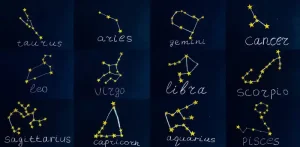
The twelve zodiacal constellations, the star patterns that lie along the ecliptic, the apparent path traced by the sun across the sky over the course of the year, occupy a special position in the cultural history of constellation names because of their dual role in astronomy and astrology and because of the degree to which they permeated the cultural life of ancient civilizations from Mesopotamia through the Greco-Roman world and beyond. The zodiacal constellations as a systematic grouping originated in Babylonian astronomy approximately three thousand years ago, with the twelve-constellation zodiac we know today reaching its definitive form around the fifth century BCE. Each zodiacal constellation marks the region of sky in which the sun appears during a specific portion of the year, and this solar association gave these constellations particular calendrical and religious significance in ancient cultures that organized their agricultural, ritual, and civic calendars around solar and seasonal cycles. The names and imagery of the zodiacal constellations reflect the mythological and symbolic vocabulary of the Babylonian and Greek cultures that shaped their development, with animal figures including Aries the ram, Taurus the bull, Cancer the crab, Leo the lion, Scorpius the scorpion, and Capricornus the sea-goat dominating the imagery alongside human figures including Gemini the twins, Virgo the maiden, and Aquarius the water bearer. The persistence of these names and images across more than two thousand years of cultural transformation, surviving the rise and fall of the civilizations that created them, the adoption of new religions, the development of modern astronomy, and the complete displacement of astrology from scientific respectability, is a remarkable testament to the cultural staying power of a naming tradition that embedded itself deeply in the symbolic vocabulary of multiple succeeding civilizations.
The Precession Problem and Why Zodiacal Constellations No Longer Match Their Dates
One of the most interesting and least widely understood aspects of zodiacal constellation names is the discrepancy between the dates associated with each zodiacal sign in popular astrology and the actual position of the sun relative to the constellations for which the signs are named. This discrepancy is the result of axial precession, the slow wobble of the earth’s rotational axis that causes the celestial poles to trace circles against the background of stars over a twenty-six thousand year cycle. Over the two thousand-plus years since the Babylonians defined the zodiacal calendar, precession has shifted the relationship between calendar dates and constellation positions by approximately one full zodiacal sign, meaning that the sun is actually in Aries when astrology says it is in Taurus, in Taurus when astrology says it is in Gemini, and so on through the entire sequence. Modern astronomy accounts for this precession in all calculations involving the positions of celestial objects relative to the background stars, but popular astrology continues to use the zodiacal date assignments established by Babylonian and Greek astronomers two millennia ago, creating a systematic offset from astronomical reality that astronomical organizations including the IAU have occasionally noted in public communications. The precession phenomenon also means that Polaris has not always been the North Star and will not remain so. The celestial pole is currently close to Polaris but is slowly moving away, and in approximately twelve thousand years it will be closest to Vega in the constellation Lyra, which will at that point serve as the navigational North Star in the same capacity Polaris serves today.
Final Thought
Constellation names are not relics of a prescientific past that modern astronomy has made irrelevant. They are living connective tissue between the human beings alive today and every generation that has ever stood beneath an open sky and felt the same pull of wonder, the same impulse to find meaning in the patterns above. When you learn to find Orion in a winter sky and understand that the three stars of his belt have been recognized and named by cultures on every inhabited continent for as far back as human history reaches, you are not just learning astronomy. You are participating in the longest continuous intellectual tradition our species has ever maintained. The sky that those ancient observers looked at is the same sky you are looking at tonight. The stars are the same stars. The patterns are the same patterns. Only the names you give them, and the stories you carry up with you when you look, are yours to choose.